For Educators
A first microscopy sequence
Start with a clear view. Build toward evidence.
Begin with the parts worksheet, practice focusing in the introductory lesson, then collect evidence at the scavenger-hunt stations. Use the comparison slides when students are ready to ask what different instruments can reveal.
Each resource includes a teacher guide, a separate student handout and a key. Equipment alternatives support shared microscopes and image-based lessons.
Put it into practice
Start a lesson with a little play
Practice focus before the microscope lab, explore scale, or make careful observations by counting cells. Each challenge takes about 2–4 minutes.
On campus · Field Lab
Focus Finder
Bring three illustrated slides into focus. Follow the detail, fine-tune the dial, and capture a clear view.
On campus · Field Lab
Scale Scramble
Think small! Put measurements in order and discover how millimeters, micrometers, and nanometers connect.
On campus · Field Lab
Cell Counter
Scan a busy field of view. Mark every illustrated cell while leaving dust specks behind.
Classroom materials
Introduction to Microscopy — Lesson Plan
A first microscope lesson with a timed teaching plan, focusing practice, observation sheet, exit ticket and assessment rubric.
Parts of a Microscope — Worksheet
An original numbered diagram, parts-and-functions table, magnification practice and safety scenarios. Includes a teacher answer key.
Electron vs. Light Microscopes — Slide Deck
20 classroom slides with real micrographs, presenter notes, comparison questions, a scale-bar exercise and a student handout.
Microscopy Scavenger Hunt — Activity
Four observation stations with printable task cards, an evidence log, group roles, flexible equipment options and teacher look-fors.
A university course
Interactive demonstrations
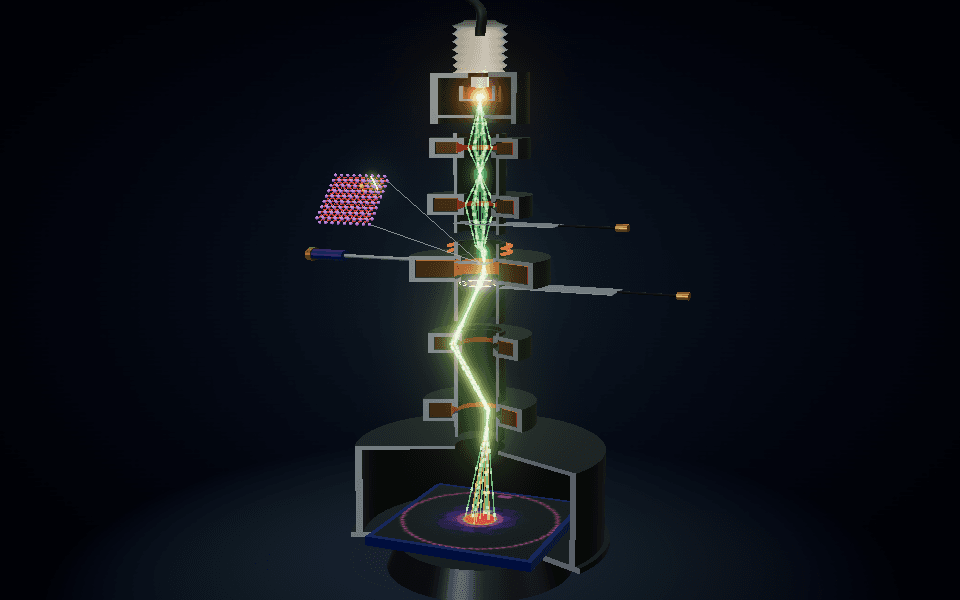
Designed around classroom routines
Teacher-authored labs and education resources informed the short demonstrations, group roles, observation logs and exit checks. Teacher discussions informed options for limited equipment. These are original materials that still need classroom testing.
Specific curriculum connections
Plant-cell observations contribute evidence toward NGSS MS-LS1-1. Parts labeling builds prerequisite skills. Each guide explains its connection and limits so you can fit the activity into your local curriculum.
Read the NGSS expectation ↗Classroom research & science sources
Reviewed October 7, 2026. Forum discussions describe individual teachers’ experiences; they are not evidence of universal practice. External lesson wording and handouts have not been reproduced.
- Biology Corner · Microscope Introduction: e Lab
Teacher-authored classroom practice: low-power focusing, drawings and observation questions.
- HHMI BioInteractive · What van Leeuwenhoek Saw
Separate educator and student materials, discussion before instruction, and reasoning about image scale.
- Science Buddies · Using a Lesson Plan
Objectives, preparation, timed investigation, assessment and adaptations in one teaching package.
- ScienceTeachers · Organizing a microscopy unit
Anecdotal teacher discussion about splitting the class for microscope instruction when equipment is limited.
- OpenStax · Instruments of Microscopy
Scientific reference for microscope parts, magnification, instrument care and imaging methods.
- Nikon MicroscopyU · Resolution
Scientific reference for the distinction between image enlargement and resolving detail.
- Open University · Electron Microscopy
Scientific reference for SEM, TEM and specimen preparation.
- NGSS · MS-LS1: From Molecules to Organisms
MS-LS1-1 concerns investigating evidence that living things consist of cells. Parts labeling alone does not meet it.
Help improve the next classroom edition
Share what worked, the age group you taught, and any changes that helped your learners.
Share teaching feedback